
Unexpected equipment failures remain one of the biggest challenges facing industrial companies today. Unplanned downtime can lead to production delays, increased maintenance expenses, lost revenue, and dissatisfied customers.
Traditional maintenance approaches often rely on fixed schedules or reactive repairs. While these methods may reduce some risks, they rarely provide the operational intelligence needed in modern manufacturing environments.
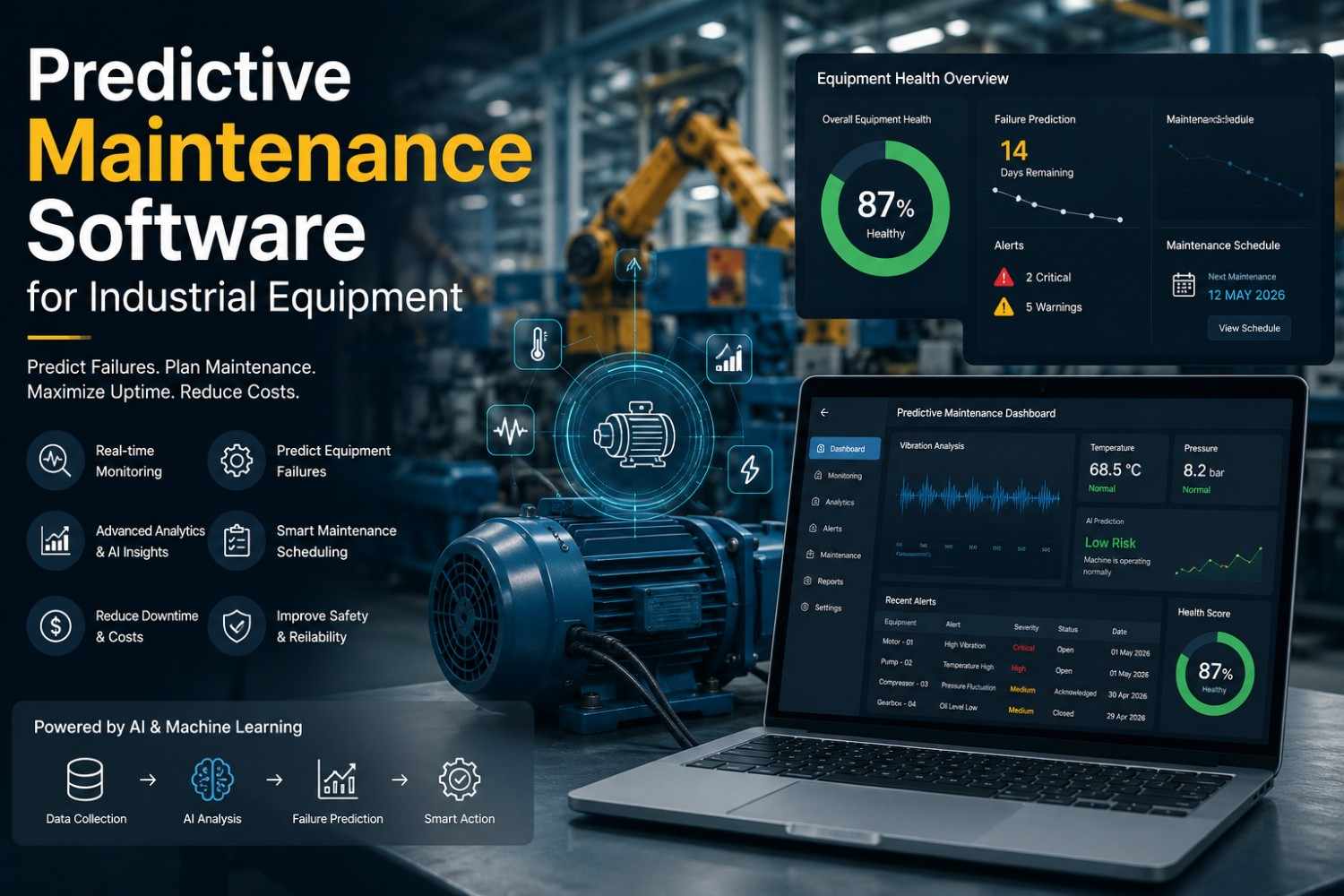
Predictive Maintenance Software offers a more advanced solution. By combining Industrial IoT, machine monitoring, artificial intelligence, and predictive analytics, organizations can identify equipment issues before failures occur.
For manufacturers seeking to improve reliability and reduce maintenance costs, predictive maintenance has become a critical component of digital transformation strategies in 2026.
What Is Predictive Maintenance Software?
Predictive Maintenance Software is a technology platform that analyzes equipment data to forecast potential failures before they happen.
The system collects information from sensors, machines, and connected devices to monitor equipment performance in real time.
The software can detect:
- Abnormal machine behavior
- Temperature fluctuations
- Vibration issues
- Pressure inconsistencies
- Energy inefficiencies
- Equipment wear and tear
By identifying early warning signs, maintenance teams can take action before breakdowns occur.
Why Predictive Maintenance Matters
Industrial organizations invest heavily in machinery, equipment, and production assets. Unexpected failures can result in:
- Production downtime
- Emergency repair costs
- Product quality issues
- Safety risks
- Reduced equipment lifespan
Predictive maintenance software helps businesses minimize these risks through data-driven maintenance strategies.
Key Benefits of Predictive Maintenance Software
1. Reduced Unplanned Downtime
Predictive maintenance software helps organizations detect issues earlier, schedule repairs proactively, and avoid production interruptions.
2. Lower Maintenance Costs
Benefits include fewer emergency repairs, lower labor costs, reduced spare parts consumption, and better maintenance planning.
3. Improved Asset Performance
Continuous monitoring leads to increased machine availability, improved efficiency, and higher Overall Equipment Effectiveness (OEE).
4. Extended Equipment Lifespan
Predictive maintenance helps prevent excessive wear and optimize maintenance timing, significantly reducing long-term replacement costs.
Core Features to Look For
Equipment Monitoring
Real-time monitoring, machine health tracking, sensor integration, and asset performance dashboards.
Predictive Analytics
Failure prediction, trend analysis, risk scoring, and performance forecasting.
Industrial IoT Integration
Integration with temperature, vibration, pressure, and energy sensors for real-time data collection.
AI-Powered Insights
AI algorithms that identify hidden patterns, detect anomalies, predict failures, and recommend maintenance actions.
How Predictive Maintenance Works
- Data Collection: Sensors continuously collect data on temperature, vibration, speed, pressure, and energy consumption.
- Data Analysis: The software uses predictive analytics and machine learning to identify failure patterns.
- Alert Generation: Automatic alerts are sent to maintenance teams when risks are detected.
- Maintenance Action: Technicians perform targeted repairs before breakdowns occur.
Predictive Maintenance vs Preventive Maintenance
| Feature | Predictive Maintenance | Preventive Maintenance |
|---|---|---|
| Based On | Equipment Condition | Fixed Schedule |
| Data Driven | Yes | Limited |
| AI Analytics | Yes | No |
| Downtime Reduction | High | Moderate |
| Maintenance Costs | Lower | Higher |
| Equipment Monitoring | Continuous | Periodic |
Industries Using Predictive Maintenance Software
- Manufacturing – Production lines, CNC machines, robotics
- Energy and Utilities – Turbines, generators, power systems
- Transportation – Fleet management, railway systems
- Mining and Construction – Heavy equipment and vehicles
Future Trends for 2026
- AI-Driven Maintenance
- Cloud-Based Maintenance Platforms
- Digital Twin Technology
- Sustainability and Energy Optimization
Frequently Asked Questions
What is predictive maintenance software?
Predictive maintenance software uses AI, Industrial IoT, and predictive analytics to forecast equipment failures before they occur.
How does predictive maintenance reduce downtime?
The software identifies potential issues early, allowing maintenance teams to perform repairs before breakdowns happen.
Is predictive maintenance suitable for small manufacturers?
Yes. Many cloud-based solutions are designed for both small and large organizations.
Conclusion
Predictive Maintenance Software has become a critical technology for modern industrial operations. By combining Industrial IoT, AI automation, predictive analytics, and equipment monitoring, organizations can reduce downtime, lower maintenance costs, improve asset performance, and increase operational efficiency.
As manufacturers continue investing in digital transformation initiatives, predictive maintenance will play an increasingly important role in helping industrial companies remain competitive in 2026 and beyond.